Key Takeaways
- Barcodes are cheapest and simplest but require a technician to scan each device one at a time.
- QR codes hold more data and scan from any smartphone angle, enabling employee self-service checks.
- RFID reads tags in bulk without line of sight, making large-scale audits dramatically faster.
- Passive RFID fits most IT fleets; active RFID suits only high-value or highly mobile assets.
- All three methods only update the record at the moment of a deliberate scan.
- Automated check-in/check-out via smart lockers captures custody changes instantly, with no scan required.
If you’re pricing out a smart vending machine for an office break room, a retail floor, or a public space, the first thing you’ll notice is that there’s no single sticker number. Two machines that look similar from the outside can differ widely in cost depending on what’s inside: the screen, the payment reader, the refrigeration unit, the software, and how you choose to pay for the whole thing.
This guide breaks down what actually drives that cost, how prices differ by machine type and how to compare buying outright, leasing, and revenue-share placement. It closes with the questions worth asking before you request a quote.
What Is a Smart Vending Machine?
A smart vending machine is a self-service dispensing unit that connects to the internet and runs on software rather than simple mechanical timers and coin mechanisms. Instead of a fixed coil-and-cash design, it uses sensors to know what’s in stock, a management platform to track sales and inventory in real time, and a payment system that accepts cards, mobile wallets, employee badges, QR codes, and sometimes biometrics.
The result is a machine that reports on itself. An operator can see which items are selling, which slots are empty, and which units need service, all remotely, without visiting the site to check. For the end user, the experience feels closer to a checkout than a coin slot: a touchscreen, a tap to pay, and a product delivered.
How Smart Vending Differs From Traditional Vending
Traditional vending is mechanical and mostly blind. The operator restocks on a schedule, guesses at demand, and only learns a machine is empty or jammed when someone complains or sales stop. Cash handling adds labor and shrinkage.
Smart vending changes the model in a few concrete ways:
- Real-time inventory: Sensors and software report stock levels per slot, so restocking follows actual demand instead of a fixed route.
- Cashless, multi-credential payment: Cards, mobile wallets, and, in workplace settings, employee badges or PINs that can tie a purchase to a cost center.
- Remote monitoring and analytics: Sales, uptime, and service alerts flow to a dashboard, cutting unnecessary site visits.
- Flexible dispensing: Newer designs move beyond spiral coils to elevator-based delivery, which handles fragile or oddly shaped items that traditional coils drop and damage.
- Integration: The better platforms connect to retail, e-commerce, or IT systems through APIs, so vending data isn’t stranded in a separate silo.
That added intelligence is also why smart machines cost more than a basic mechanical unit. You’re paying for the electronics, the software, and the connectivity, not just the cabinet.
Smart Vending Machine Pricing: What Drives the Cost
There’s no honest way to quote a single smart vending machine price without knowing the configuration. The machine is a bundle of choices, and each one moves the number. It helps to think about cost in two buckets: the hardware you buy once, and the software and support you pay for over time.
1. Hardware Configuration (Screen, Payment, Refrigeration)
The physical build is usually the largest share of the upfront cost. The main factors:
- Size and capacity: A compact countertop or wall unit costs far less than a full-height, high-capacity machine or a multi-module system built to scale.
- Touchscreen and interface: A small status display is entry-level; a large HD touchscreen for browsing, promotions, and video sits at the premium end.
- Payment hardware: A basic card reader is one tier; adding badge/RFID readers, PIN pads, QR scanning, or biometric authentication raises it.
- Refrigeration: Cooling is one of the biggest cost drivers. An ambient snack machine is cheaper than a beverage cooler, which is cheaper than a temperature-controlled unit rated for fresh or perishable food.
- Dispensing mechanism: Simple coils are the low-cost baseline; elevator-based or robotic delivery that protects fragile and non-standard items costs more but reduces damage and jams.
- Enclosure and compliance: Ruggedized builds for outdoor or high-traffic public use, and ADA/508-compliant designs, add to the base.
Here’s how those factors tend to stack up in relative terms:
| Cost driver |
Entry tier |
Mid tier |
Premium tier |
| Size / capacity |
Countertop, low count |
Full-height single unit |
Multi-module, high capacity |
| Screen |
Status display only |
Small touchscreen |
Large HD touchscreen |
| Payment |
Single card reader |
Card + mobile wallet |
Card, badge/RFID, QR, biometric |
| Refrigeration |
Ambient (none) |
Beverage cooler |
Fresh/perishable, temp-controlled |
| Dispensing |
Spiral coils |
Mixed coil/tray |
Elevator-based / robotic |
2. Software, Connectivity, and Support Fees
The hardware is a one-time purchase; the platform that makes it “smart” is usually an ongoing cost. Expect some combination of:
- Software/platform subscription: The cloud dashboard for inventory, sales reporting, remote monitoring, and user management, typically billed per machine per month.
- Connectivity: Cellular or network data so the machine stays online and reports in real time.
- Payment processing: Transaction fees charged by the payment provider on cashless sales.
- Support, warranty, and maintenance: Service-level coverage, parts, and field service. In-house manufacturing matters here: when the maker also services the machine, parts and reconfiguration are simpler than chasing a third party.
- Integrations: Connecting the machine to retail, e-commerce, or IT/ITSM systems, which may carry setup or licensing costs.
When you compare quotes, separate the one-time hardware price from the recurring per-machine software and support fees. A low hardware price paired with high monthly fees can cost more over three years than the reverse.
Remember – Vending is a large, established market, which keeps options broad. The convenience services industry that vending sits within delivers roughly a $40 billion U.S. economic footprint according to the National Automatic Merchandising Association (NAMA), and the industry generated $26.6 billion in revenue in 2023, with vending accounting for about 68% of that. That scale means real variety in what you can buy and real variation in price.
Pricing by Machine Type
Beyond configuration, the category of machine sets a baseline. Refrigeration and capacity are the big movers, so cost climbs as you go from ambient snacks to compact coolers to full fresh-food units. Here are some key types:
Smart Snack and Beverage Coolers
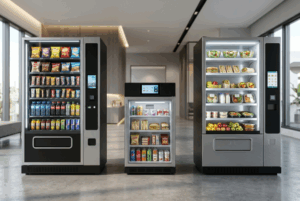
Snack and beverage machines are the workhorses of workplace and retail vending. Ambient snack units, chips, bars, and packaged goods sit at the lower end because they don’t cool. Add a refrigerated beverage section, and cost rises with the cooling system and its energy draw. These machines suit break rooms, lobbies, gyms, and retail floors where the product mix is shelf-stable or chilled drinks.
Smart Mini Fridges and Compact Units
A smart mini vending machine, a compact, often countertop or wall-mounted cooler, serves smaller footprints: a huddle room, a clinic, a boutique, or a spot where a full-height machine won’t fit. Compact units generally carry a lower hardware price simply because there’s less machinery, though a small smart fridge vending unit with a good screen and full payment stack can still land in the mid tier. These are a common entry point for a first pilot before scaling up.
Smart Fridge Vending for Fresh/Perishable Goods
Smart fridge vending for fresh salads, sandwiches, dairy, and other perishables sits at the top of the range. Tight temperature control, food-safety monitoring, and sometimes shelf-life tracking all add hardware and software costs, and the platform often needs to flag expired stock and log temperatures. The payoff is access to fresh food and prepared meals in places that can’t staff a café, like hospitals, campuses, transit hubs, and offices, thereby moving beyond snacks. Elevator-based dispensing is common here because it handles delicate, non-standard packaging without dropping it.
Buy, Lease, or Revenue-Share: Comparing Acquisition Models
How you pay for a machine can matter as much as which machine you pick. There are three common paths, and the right one depends on your capital budget, how much control you want, and whether the machine is a service you provide or a business you run.
Upfront Purchase
Buying outright means you own the hardware. You pay the full price at purchase (plus the ongoing software and support fees), and the machine is yours. Full control over product, pricing, branding, and placement, with the lowest long-term cost per machine if it runs for years.
The trade-off is capital. Purchase ties up the budget upfront and puts maintenance planning on you (usually through a warranty or service contract). It fits organizations that want ownership, run many machines, or treat vending as part of their workplace or retail experience rather than a side revenue stream.
Leasing and Subscription Options
Leasing or a hardware subscription spreads the cost into predictable monthly payments instead of one large outlay. That protects cash flow and often bundles software, support, and upgrades into a single recurring fee. It’s a good fit when capital budget is tight, when you want to pilot before committing, or when you’d rather keep the machine on a refresh cycle than own aging hardware.
The trade-off is total cost: over a long enough horizon, leasing usually costs more than buying, and terms vary on what happens at the end: return, renew, or buy out.
Revenue-Share Placement Agreements
In a revenue-share (or placement) model, a vending operator installs and stocks the machine at little or no upfront cost to you, and you share a percentage of sales. It’s the lowest-commitment option: minimal capital, and the operator usually handles restocking and service. The trade-off is control and margin. You give up a cut of revenue, and the operator typically decides the product mix and pricing. It fits high-traffic sites where foot traffic makes the machine attractive to an operator, and where you’d rather offer the amenity than manage it.
Here’s how the three models compare:
| Model |
Upfront cost |
Ongoing cost |
Ownership |
Best fit |
| Buy |
High (full hardware price) |
Software, support, processing |
You own the machine |
Multi-unit programs; want full control and lowest long-term cost |
| Lease / subscription |
Low to none |
Fixed monthly payment (often bundled) |
Operator/lessor until any buyout |
Tight capital; piloting; want a refresh cycle |
| Revenue-share |
Little to none |
Share of sales to operator |
Operator owns and stocks |
High-traffic sites; want the amenity without managing it |
Where to Buy Smart Vending Machines
Once you know the configuration and model, the next question is who you buy it from. A search for a “smart vending machine for sale” or “smart snacks vending machines for sale” turns up two broad routes: buying direct from the manufacturer or going through a distributor or operator.
Buying Direct vs. Through a Distributor
Buying direct from the manufacturer puts you closest to the people who design, build, and service the hardware. That usually means better configuration options, clearer answers on customization and compliance, faster parts and support, and one accountable party for hardware and software together. For programs that need machines matched to a specific space or product mix, or that plan to scale, direct is often the cleaner path.
Buying through a distributor or operator can be faster for a single standard machine and is the natural route for revenue-share placement, where the operator owns and stocks the unit. The trade-off is another layer between you and the maker, which can slow custom requests and service.
Questions to Ask Before You Request a Quote
Before you ask for pricing, get specific. The answers change the number and the fit:
- What’s the one-time hardware price versus the recurring software, connectivity, and support fees?
- Which payment methods are included, and which are add-ons (badge/RFID reader, extra screen, biometric)?
- Is refrigeration standard on this model, and is it rated for beverages or for fresh/perishable food?
- Who handles installation, service, and parts, and how fast is field response?
- Can the machine be reconfigured later without swapping hardware, and is it ADA/508-compliant?
- Does the platform integrate with our retail, e-commerce, or IT/ITSM systems?
- What are the buy, lease, and revenue-share options, and what does total cost look like over three years for each?
Choosing the Right Configuration for Your Space
The best configuration is the one that matches the room and the people using it. Product mix, foot traffic, payment expectations, and available space should drive the spec, not the other way around.
Workplace break rooms favor employee-friendly features: badge or PIN payment tied to a cost center, subsidized or free-vend options, and a product mix from snacks and drinks to fresh food. Reliability and quiet operation matter more than flashy screens, and integration with facilities or IT systems is often useful. Compact and mid-tier units cover most offices; larger sites moving to fresh food step up to temperature-controlled machines.
Retail and public spaces put a premium on the customer-facing experience: a large touchscreen for browsing and promotions, broad consumer payment options, durable enclosures for high traffic, and a look that fits the brand. Here, the machine is a point of sale, so uptime, analytics, and click-and-collect (BOPIS) integration carry weight. This is also where modular systems earn their keep. You can scale capacity as demand grows instead of buying a second standalone machine.
How Signifi Can Help With Smart Vending
Understanding the pricing model is the easy part. The harder part is getting a machine that fits your space, your product mix, and your systems, and keeping it running once it’s placed. That’s where the equipment maker matters.
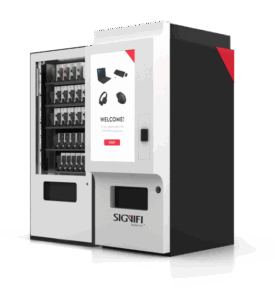
Signifi designs, engineers, and builds its smart vending and dispensing hardware in-house, run by one cloud platform, SignifiVISION™. The Spark series is a modular smart vending line: coil-free, elevator-based delivery that handles everything from headphones and keyboards to snacks, drinks, and larger retail goods without the drops and jams of spiral coils. A 42-inch HD touchscreen drives the interface, and the machine accepts employee cards, PINs, QR codes, RFID, and biometric authentication. Because the design is modular, you can attach multiple units to a single control to scale capacity, and machines can be reconfigured in the field without hardware swaps. Every build is manufactured and serviced by the same company, and units are ADA/508-compliant.
SignifiVISION handles the smart layer: real-time inventory, sales analytics, remote monitoring, and retail, e-commerce, or IT-system integration through APIs. The same platform runs Signifi’s smart automated retail and lockers, so vending can sit alongside click-and-collect and asset dispensing in one system. If you’re weighing buy, lease, or placement across offices, retail, or public sites, contact us to size a configuration and price it for your space.
FAQ
How much does a smart vending machine cost?
There’s no single price. Cost depends on size, screen, payment hardware, refrigeration, and dispensing type, plus ongoing software and support fees. Ambient snack units sit at the low end; large, temperature-controlled fresh-food machines with full touchscreens and multi-credential payment sit at the top. The most reliable way to get a real number is to configure the machine and request a quote.
What’s the difference between a smart vending machine and a traditional one?
A traditional machine is mechanical and reports nothing. A smart machine connects to the internet, tracks inventory in real time with sensors, accepts cashless and badge payments, and sends sales and service data to a remote dashboard. That intelligence is why it costs more than a basic mechanical unit.
Is it cheaper to buy or lease a smart vending machine?
Buying has the highest upfront cost but the lowest long-term cost per machine if it runs for years. Leasing spreads payments into a predictable monthly fee that often bundles software and support, which protects cash flow but usually costs more over a long horizon. Revenue-share placement has little to no upfront cost but gives up a share of sales and most control to the operator.
What is a smart mini vending machine?
It’s a compact cooler or dispenser, often countertop or wall-mounted, for small spaces like huddle rooms, clinics, or boutiques. It carries a lower hardware price than a full-height machine because there’s less machine, though adding a touchscreen and full payment options can move it into the mid tier. Compact units are a common way to pilot before scaling.
What drives the cost of smart fridge vending for fresh food?
Temperature control and food safety. Fresh and perishable machines need tight cooling, temperature monitoring, and often shelf-life tracking in software to flag expired stock, all of which add hardware and platform cost. Elevator-based dispensing is common in these units because it protects delicate packaging.
Where’s the best place to buy a smart vending machine?
You can buy directly from the manufacturer or through a distributor or operator. Direct usually gives you more configuration options, faster parts and service, and one accountable party for hardware and software, useful for custom or scaling programs. Distributors and operators suit a single standard machine or a revenue-share placement where the operator owns and stocks the unit.

