Key Takeaways
- Smart locker ServiceNow integration closes the gap between digital asset approvals and the physical device handoff.
- The architecture relies on three components: REST APIs, webhooks, and CMDB synchronization.
- Every pickup, return, or exchange becomes a real-time event that updates ServiceNow asset records automatically.
- Four workflows gain the most: new-hire provisioning, break/fix exchanges, offboarding recovery, and peripheral distribution.
- The software layer — not the locker hardware — determines whether the integration scales and stays auditable.
Over the years, enterprises have invested heavily in platforms like ServiceNow to automate requests, approvals, procurement, inventory management, and lifecycle governance. As a result, IT teams have gained unprecedented visibility into what assets they own, where those assets are supposed to be, and who is responsible for them. Yet a critical gap remains between the digital workflow and the physical movement of devices. A laptop can be approved in minutes. But someone still needs to hand over the asset.
As organizations face faster service expectations, this physical-digital disconnect is becoming harder to ignore. The next stage of ITAM maturity is no longer about improving asset visibility. It is about orchestrating how assets move through the enterprise. That is why forward-looking organizations are beginning to integrate smart lockers directly into ITAM ServiceNow workflows.
The physical-digital handoff gap in standard ServiceNow ITAM
ServiceNow ITAM has transformed how organizations manage the digital side of asset lifecycles. From procurement and approvals to asset assignment and retirement, enterprises can automate and track virtually every stage of an asset’s journey through a centralized platform. However, a gap emerges when an asset needs to physically move from one person or location to another. A laptop may be approved and assigned in ServiceNow, but the actual handoff often depends on manual coordination, service desk involvement, shipping processes, or local inventory teams.
This disconnect between digital workflows and physical asset movement creates what many organizations now recognize as the physical-digital handoff gap. While ServiceNow can accurately record who should receive a device and when, it does not control the moment the asset is collected, exchanged, or returned. As a result, IT teams often struggle with:
- Delayed provisioning
- Inconsistent chain-of-custody records
- Asset status updates that lag behind real-world events
In an era where employees expect on-demand service and organizations require stronger governance, closing this gap has become essential to achieving true end-to-end IT asset automation.
Smart locker ServiceNow integration architecture: REST APIs, webhooks, CMDB sync
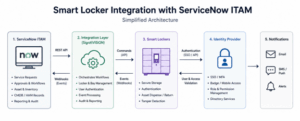
A successful smart locker integration is not simply about connecting a locker to ServiceNow. It is about creating an event-driven architecture where physical asset transactions automatically trigger updates across ITAM, ITSM, identity, and inventory systems. In this model, ServiceNow remains the system of record for assets, tickets, approvals, and workflows, while the smart locker platform serves as the execution layer that manages physical access and custody events.
REST APIs: Connecting ServiceNow to Physical Asset Workflows
At the center of this architecture are REST APIs, which enable bi-directional communication between ServiceNow and the smart locker platform. When an onboarding request is approved, ServiceNow can use APIs to create a locker reservation, assign a specific asset to a user, allocate a compartment, and initiate notifications. Similarly, the smart locker platform can retrieve user information, asset details, and workflow instructions directly from ServiceNow, ensuring that both systems remain aligned throughout the asset lifecycle.
This API-driven approach allows organizations to automate processes that would otherwise require manual coordination between IT teams, inventory managers, and end users. Instead of relying on emails, spreadsheets, or service desk appointments, asset distribution becomes a structured workflow governed by enterprise systems.
Webhooks: Turning Physical Events Into Workflow Actions
While APIs allow systems to exchange information, webhooks ensure that physical events are communicated back to ServiceNow in real time. Whenever a significant action occurs, such as a locker compartment being assigned, a user authenticating successfully, an asset being collected, or a device being returned, the smart locker platform can automatically send an event notification to ServiceNow.
This real-time communication allows workflows to progress without human intervention. For example, a laptop pickup can automatically update a service request, while a failed pickup after a predefined SLA can trigger reminders, escalation workflows, or compartment reassignment. Rather than treating the locker as a passive storage location, webhooks transform it into an active participant in enterprise workflows.
CMDB Synchronization: Maintaining a Single Source of Truth
The true value of this architecture lies in CMDB synchronization. Many organizations struggle because asset records often fail to reflect what is happening in the real world. Devices may be deployed, returned, exchanged, or relocated without corresponding updates being made in the CMDB.
By integrating smart locker events directly with ServiceNow’s CMDB and Hardware Asset Management records, every physical transaction becomes a digital update. When an employee collects a laptop, the asset can automatically move from “reserved” to “assigned.” When a returned device is deposited in a locker, its status can change to “pending inspection,” while follow-up tasks are generated automatically for the support team.
Four ITAM ServiceNow workflows that benefit most with smart locker integration
According to a Snowgeek study, integrated ITOM/ITAM implementations deliver 60% better ROI than siloed approaches. This is largely due to four ServiceNow workflows that bridge the gap between digital workflows and physical asset movement. These are the workflows where smart locker integration delivers the most immediate impact by eliminating manual handoffs, improving asset visibility, and creating a verifiable chain of custody:
New-Hire Device Provisioning
Employee onboarding is often a race against time. While ServiceNow can automate approvals, procurement requests, and asset assignment, the final step of getting the device into the employee’s hands frequently depends on service desk availability or shipping logistics. By integrating smart lockers into the onboarding workflow, organizations can automatically reserve a locker compartment, notify the employee, and record the pickup event in real time. This enables faster onboarding while reducing the administrative burden on IT teams.
Break/Fix Device Exchanges
When a device fails, every hour of downtime impacts productivity. In a traditional process, users often wait for IT staff to coordinate a replacement or process a return. With smart locker integration, a ServiceNow incident can automatically trigger a replacement device reservation while simultaneously creating a return workflow for the faulty asset. Employees can complete the exchange on their own schedule, while ServiceNow maintains accurate records of both devices throughout the process.
Employee Offboarding and Asset Recovery
Recovering company-owned devices remains one of the biggest challenges in asset management. ServiceNow can generate offboarding tasks, but ensuring assets are physically returned often requires manual follow-up. Smart lockers provide a secure and auditable return point that automatically records when an asset is deposited. The return event can then trigger status updates, inspection tasks, and redeployment workflows, helping organizations reduce asset loss while maintaining stronger governance controls.
Peripheral and Security Asset Distribution
Not every IT asset justifies a service desk interaction. Peripherals such as keyboards, headsets, monitors, and docking stations, as well as high-value security assets like hardware authentication keys, are frequently requested but cumbersome to distribute manually. Smart lockers allow these items to be issued through ServiceNow workflows while maintaining inventory visibility and accountability. The result is a self-service experience for employees and a more efficient operating model for IT.
What to Look for in a Smart Locker Solution That Integrates With ServiceNow?
As smart lockers become an extension of enterprise ITAM workflows, organizations need to evaluate them differently than traditional storage or access-control systems. The goal is not simply to automate asset pickup and returns. The goal is to create a seamless connection between physical asset movements and the digital systems that govern them. A locker may store a laptop, but the platform behind it should be capable of updating asset records, triggering workflows, enforcing access policies, and maintaining an auditable chain of custody.
When evaluating a smart locker solution for a ServiceNow environment, consider the following capabilities:
Open APIs and Workflow Integration
A modern smart locker platform should integrate easily with ServiceNow ITAM, ITSM, and HAM workflows. Look for REST APIs and webhook capabilities that enable real-time communication between systems. Whether the workflow involves onboarding, break-fix exchanges, or asset returns, the locker platform should be able to both receive instructions from ServiceNow and send event data back automatically.
Real-Time Asset and CMDB Locker Sync
The value of integration depends on the quality of data it generates. Every pickup, return, exchange, or exception event should automatically update the relevant asset records and CMDB entries. Without this synchronization, organizations risk creating another operational silo that requires manual updates and reconciliation.
Flexible Authentication Options
Security and convenience must work together. The ideal solution should support multiple authentication methods, including employee badges, single sign-on, mobile credentials, QR codes, and multi-factor authentication. This allows organizations to align locker access with their existing identity and access management strategy.
End-to-End Chain of Custody
One of the biggest advantages of smart lockers is the ability to create verifiable records of asset movement. Look for platforms that capture who accessed an asset, when the transaction occurred, where it happened, and what action was taken. These records help improve accountability, simplify audits, and strengthen asset governance.
Scalability Across Multiple Locations
Many organizations begin with a single deployment but quickly expand to multiple offices, warehouses, retail locations, or service centers. A smart locker solution should be centrally managed and capable of supporting consistent workflows across all locations without increasing administrative complexity.
Operational Reporting and Analytics
The best smart locker deployments generate more than transaction records. They provide actionable insights. Reporting capabilities should include asset utilization, pickup success rates, return compliance, inventory levels, workflow bottlenecks, and exception trends. These insights help IT leaders continuously optimize asset operations and improve service delivery.
Beyond Hardware: The Importance of the Software Layer
Perhaps the most important evaluation criterion is the software platform behind the locker. The hardware controls physical access, but the software orchestrates workflows, manages integrations, processes events, and delivers visibility across the asset lifecycle. Solutions such as SignifiVISION are designed with this broader objective in mind, connecting smart lockers with enterprise platforms like ServiceNow while providing the ITAM automation, reporting, and governance capabilities required to scale asset operations.
How SignifiVISION Connects Physical Asset Management With ServiceNow Workflows
The true challenge in IT asset management is not tracking assets. It is orchestrating how those assets move through the organization while maintaining visibility, accountability, and control. This is where SignifiVISION plays a critical role.
SignifiVISION serves as the operational layer between smart lockers and enterprise systems such as ServiceNow ITAM, ITSM hardware automation systems, CMDB, identity providers, HRIS platforms, and procurement systems. Rather than treating smart lockers as standalone hardware, SignifiVISION transforms them into intelligent workflow endpoints capable of participating in enterprise-wide automation. The platform manages locker reservations, user authentication, asset allocation, event processing, notifications, and reporting, ensuring that physical asset transactions are synchronized with digital workflows in real time.
For example, when a ServiceNow onboarding request is approved, SignifiVISION can automatically reserve a locker compartment, assign the appropriate device, and notify the employee with collection instructions. Once the employee authenticates and retrieves the device, the transaction can trigger updates to asset records, custody logs, and workflow statuses. The same approach can be applied to break-fix exchanges, offboarding asset returns, hardware security key distribution, and peripheral management.
Beyond workflow automation, SignifiVISION provides the governance capabilities that enterprises need to scale these operations confidently. Organizations can leverage role-based access controls, multiple authentication methods, real-time monitoring, audit trails, and operational reporting to maintain visibility across the entire asset lifecycle. Every pickup, return, or exchange becomes a recorded event that contributes to a verifiable chain of custody and a more accurate asset inventory.
This combination of smart lockers, enterprise software integration, and operational intelligence enables organizations to move beyond manual asset distribution ServiceNow models. Instead of relying on service desk appointments, shipping processes, or inventory rooms, IT teams can create self-service experiences that improve employee satisfaction while reducing administrative effort. The result is a more connected and efficient asset management ecosystem where physical transactions become actionable business data.
Final Thoughts
The future of IT asset management is not just about knowing where assets are. It is about creating a seamless connection between digital workflows and physical asset movements. As organizations continue to invest in ServiceNow ITAM, the next opportunity lies in eliminating the manual handoffs that slow down onboarding, device exchanges, asset recovery, and inventory management. Smart locker integrations help close this gap by turning physical transactions into real-time workflow events, creating stronger governance, better asset visibility, and a more efficient experience for both IT teams and end users.
If you’re exploring ways to extend your ServiceNow workflows into the physical world, Signifi’s combination of smart lockers, automated dispensing solutions, and the SignifiVISION platform can help you build a more connected and automated asset management ecosystem. Learn more about how Signifi helps organizations automate asset distribution, improve chain of custody, and streamline enterprise operations by exploring their automated retail and smart locker solutions.

